

🇺🇸 Inside POLITICO’S Security Summit
How America’s defense, diplomacy, and industrial base are evolving to meet the challenges of the next era of global conflict

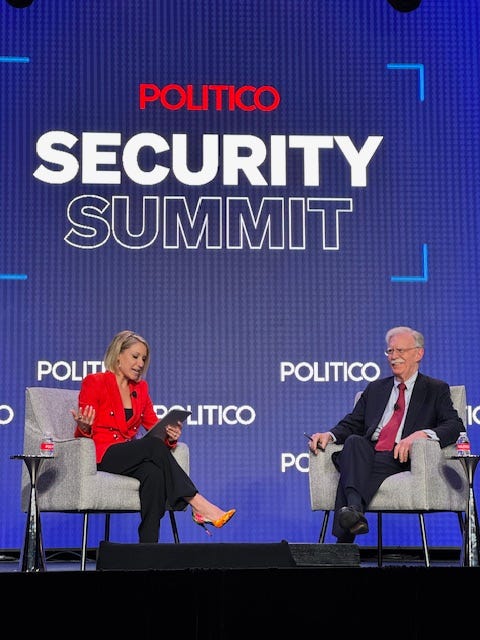
At the Politico Security Summit on May 15, 2025, national security leaders, lawmakers, defense experts, and industry insiders gathered to explore the future of U.S. defense. Covering topics from space and AI to shipbuilding and procurement, the summit delivered one clear message: progress is too slow and inefficient.
Across ten sessions and dozens of viewpoints, several clear themes emerged:
🧭 1. Strategic Realignment: The Post–Post–Cold War Reality
Rep. Adam Smith (D-Wash.) set the tone by declaring that we’ve officially entered the post–post–Cold War era. It’s not just about spending more on defense—it’s about spending smarter, investing in alliances, and recognizing that deterrence today looks vastly different than it did historically.
Sen. Eric Schmitt (R-Mo.) emphasized America’s failure to reassess its global role after the Cold War. “America cannot be everywhere, all at once, all the time,” he said, urging policymakers to shed the old hubris that has prevented meaningful adjustment.
🛠️ 2. Shipbuilding, Procurement & the Atrophied Industrial Base
A bipartisan alarm echoed throughout the summit: the U.S. defense industrial base is not ramping up production fast enough to stay ahead in the next great-power conflict. Speakers referenced China’s 232:1 advantage over the U.S. in shipbuilding capacity.
Rep. Rob Wittman (R-Va.) and Rep. Adam Smith (D-Wash.) both called for urgent acquisition reform and shipyard revitalization, while McKinsey’s Brooke Weddle noted the U.S. will need over 300,000 skilled shipbuilders by 2028 to meet the U.S. Navy demand signal. With the U.S. ownership of commercial shipping at just 0.1% compared to China’s 90%, this isn’t just a security issue—it’s an economic one.
🚀 3. Space: The Rising Theater of Strategic Competition
Space is no longer a neutral frontier—it’s a contested warfighting domain. Gen. B. Chance Saltzman warned that China’s expanding “kill web” of satellites poses a direct threat to U.S. communications and targeting systems. He emphasized the need for both reversible and destructive capabilities, such as jamming and satellite capture, to maintain dominance. The U.S. must continue to expand its capabilities to “disrupt, deny, and ultimately dominate in space”. At the same time, he stressed the importance of managed growth within the Space Force, warning that efforts to scale up must not compromise the shared industrial base that supports civil, commercial, and military space sectors. With training conducted in simulated environments and increasing reliance on high-tech personnel, Saltzman described the Space Force as “the envy of the world.”
Sen. Mark Kelly expressed confidence in America’s current warfighting capabilities but cautioned about the coming decade, with missile defense systems still incomplete and China rapidly emerging as a true peer competitor. He identified China as the most significant medium- and long-term national security threat, noting its growing investment in innovation rather than reliance on stolen technology. Kelly also criticized inconsistent NASA funding and shifting mission priorities, arguing that abrupt changes from Congress or the White House undermine long-term innovation and weaken national security. He questioned whether the Department of Defense is fully aligned on the urgency and scale of the China challenge.
🤖 4. AI Is the Battlefield Multiplier
Humans alone can’t manage the volume and complexity of modern intelligence. Emerging tech leaders like Palantir’s Shannon Clark emphasized that the future of warfare will hinge on software, not just hardware. With overwhelming volumes of data and systems, AI is essential for military readiness, logistics, and intelligence—tasks humans alone can’t manage at scale. Clark argued that maintaining a national security edge means investing in cutting-edge commercial tech and sharing it with allies, particularly NATO, to build collective strength. She also pushed for greater government adoption of ready-made commercial solutions rather than reinventing them in-house.
Matt Cronin of Andreessen Horowitz warned that China is reverse-engineering American strategy, and the only way to counter that is by out-innovating them with scalable, decentralized tools—especially drones. Cronin also stressed that the U.S. must overcome internal challenges in procurement and implementation, noting that China’s edge may come not from superior tech, but from faster manufacturing and deployment.
🧨 5. Iran, Israel, and a Fractured Middle East
John Bolton, Jake Sullivan, and Rep. Mike Lawler (R-N.Y.), offer sharply contrasting views on U.S. strategy in the Middle East, but all highlight the region’s volatility and the high stakes for American foreign policy. Bolton criticizes Trump’s ad hoc decision-making and lack of a clear national security strategy, warning that lifting Syria sanctions without full transparency into Assad’s past regime is dangerous, given the new government’s unclear ties to terrorists. He also faults Trump for being soft on Putin, arguing that weak enforcement of sanctions has only emboldened Russia.
Sullivan, in contrast, calls for patient, principled diplomacy—especially with Iran—insisting the U.S. should have remained in the 2015 nuclear deal. He emphasizes the need for strong alliances and sustained pressure on Russia, rather than short-term concessions that amount to a fragile or false peace. Lawler takes a harder line, demanding a ban on uranium enrichment in any Iran deal and urging military readiness if diplomacy fails. He sees Iran as the greatest threat in the region and calls for cutting off Iran’s oil trade with China as crucial to weakening its proxy networks. Lawler also urges regional players like Egypt, Turkey, and Qatar to align firmly with the U.S., while emphasizing stronger military and diplomatic ties with Saudi Arabia and India as key to securing long-term peace and stability in the region.
🇹🇼 6. Taiwan, Deterrence, and the China Question
In discussions on the Indo-Pacific, Reps. Michael McCaul (R-Texas) and Raja Krishnamoorthi (D-Ill.) both stressed that deterrence is essential to avoiding conflict with China. It’s crucial for China to understand that, on a bipartisan level, the U.S. will do everything to deter economic and military aggression against us and our allies.
Rep. Michael McCaul (R-Texas) highlights rising tensions in the Indo-Pacific, stressing that Taiwan’s freedom depends on strong U.S. deterrence, including support through AUKUS and advanced weapons, while avoiding provocative language that challenges the “one China” policy. He notes Xi Jinping is closely watching Ukraine’s conflict, weighing risks before acting on Taiwan. McCaul warns that China’s potential invasion of Taiwan would threaten global tech supply chains, given Taiwan’s dominance in semiconductor production, and calls for increased U.S. chip manufacturing. He frames the situation as a great power competition where strong diplomacy and alliances are essential to avoid escalation.
Krishnamoorthi (D-Ill.) advocates funding the Taiwan Allies Act and codifying the Six Assurances. He also raises serious concerns that U.S. high-tech sales and exports to the Middle East (i.e. the deals Trump announced during his trip last week) could end up in China’s hands, weakening U.S. security. Highlighting China’s expanding influence through its Belt and Road Initiative, Krishnamoorthi points to the loss of U.S. soft power tools like USAID, which has allowed countries such as Colombia to deepen ties with China through long-term infrastructure deals—posing significant economic and strategic challenges for the U.S.
🧠 7. Intelligence, Soft Power, and the Fight at Home
Rep. Jim Himes (D-Conn.) and Rep. Rick Crawford (R-Ark.) addressed emerging technology in warfare and the politicization of intelligence, respectively, as well as the weakening of America’s soft power tools like USAID.
Himes (D-Conn.) raised serious security concerns about accepting a jet from Qatar, underscoring the importance of protecting Air Force One. He praised the president’s recent measured Middle East diplomacy but condemned the Trump administration’s damaging actions toward Ukraine and questionable UN stances. Himes stressed the necessity of demonstrating unwavering Western support to deter Russia, while criticizing the Pentagon’s slow adaptation to new defense needs and Trump’s attacks on U.S. universities, which have undermined crucial research and development, threatening America’s technological edge.
Crawford (R-Ark.) warned that intelligence gaps have left America’s neighborhood unguarded as some nations say they prefer the U.S. but still sign deals with China due to a lack of viable alternatives—especially with the loss of USAID. He called for a broader, long-term strategy focused on strengthening partnerships and securing the Western Hemisphere, stressing the need for direct diplomacy, especially to prevent Iran from acquiring nuclear capabilities.
💬 Final Takeaway
The summit made clear that the U.S. stands at a pivotal strategic crossroads. Power today isn’t guaranteed by dominance alone but earned through a blend of deterrence, credibility, and readiness—militarily, economically, and diplomatically. Success will require moving beyond outdated approaches to embrace agile strategies that modernize defense, rebuild alliances, and leverage technology. How swiftly and decisively America adapts to this complex, multipolar world will determine its ability to lead and secure its interests in the years ahead.
I think agile strategy is my take-away from this. Complex issues, in a myriad of different directions, will demand a multi-prong approach to successfully emerge from this decade intact!
I appreciate you crafting this insightful reading! Thank you!😍🙏🏻